
What we are living through is not just individual stress, burnout, or anxiety.
It is collective trauma.
It lives in the air between us. In the headlines we cannot unread. In the quiet tension we carry without realizing it. In the fatigue and heaviness we feel.
And for many—especially women, especially daughters of diaspora, especially those carrying ancestral histories of displacement, war, and survival—this moment is not new.
It is familiar.
The Body Is Not Separate From the World
In Traditional East Asian Medicine, the body is not an isolated system.
It’s a relationship with things inside us and around us.
We are in constant exchange with:
- the environment
- the emotional climate around us
- our communities
- and the legacy of our ancestors
This exchange is mediated through Qi—our vital energy.
Qi is not just what moves within you. It is what connects you to everything around you.
So when the world is in a state of chronic fear, grief, or instability, it doesn’t stay “out there.”
It enters the body.
Collective Trauma as a Disruption of Qi, Blood, and Shen
From a Traditional East Asian Medicine perspective, collective trauma is not just psychological.
It is physiological. Energetic. Spiritual.
It disrupts the movement of:
- Qi (energy and function)
- Blood (nourishment and grounding)
- Shen (spirit, consciousness, presence)
When these are disturbed over time, the body begins to speak.
How This Shows Up in the Body
You might recognize this in patterns like:
Liver Qi Stagnation (Wood Element)
When there is prolonged frustration, injustice, or constriction in the external world, the Liver’s role of keeping Qi flowing smoothly becomes impaired.
This can feel like:
- irritability or emotional buildup
- tightness in the chest or shoulders
- hormonal imbalances
- a sense of being stuck, both physically and emotionally
Heart Shen Disturbance (Fire Element)
The Heart houses the Shen—your spirit, your sense of self, your ability to feel connected and at ease.
When exposed to ongoing fear, grief, or overstimulation:
- sleep becomes disturbed
- anxiety increases
- there may be a sense of disconnection or restlessness
- joy feels harder to access
Spleen Qi Deficiency (Earth Element)
The Spleen helps us process—not just food, but thoughts, emotions, and experiences.
When overwhelmed:
- fatigue deepens
- brain fog appears
- the body feels heavy or depleted
- it becomes harder to “digest” life
Kidney Jing Depletion (Water Element)
The Kidneys hold Jing—your deepest reserves of energy, often understood as your constitutional and ancestral inheritance.
When stress becomes chronic or existential:
- exhaustion feels profound and long-lasting
- fear becomes more present
- there is a sense of depletion at the core
This is where collective trauma begins to touch something deeper.
Why Some People Feel This More Deeply
Not all people experience collective trauma in the same way.
In Traditional East Asian Medicine, we understand that we inherit our constitution through Jing, representing foundational vitality and longevity stored in the Kidneys.
But through a modern, decolonial lens, we can also recognize that what is passed down includes:
- survival patterns
- unprocessed grief
- nervous system adaptations
- and the imprint of historical trauma
For communities shaped by colonization, migration, or systemic harm, the body may already be holding layers of unresolved experience.
So when new waves of collective trauma arise, they don’t land on neutral ground.
They land on bodies that are already carrying generations of trauma.
It is a reflection of how much has been held—across time, across generations, within the tissues of the body itself.
Beyond the Individual: Healing Happens in Relationship
In many modern approaches, healing is framed as something that is an individual responsibility.
- Regulate yourself.
- Manage your symptoms.
- Take care of your body.
But from a Traditional East Asian Medicine perspective, this is incomplete.
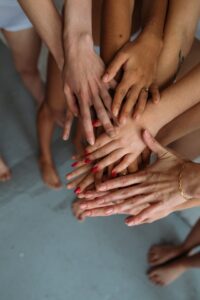
Because the body was never meant to function in isolation but in community.
- Qi moves in relationship with what is happening inside of us as well as what is happening outside of us.
- The body is intimately connected to the mind, emotion, and spirit.
- The body restores itself not only through internal practices—but through being held in the right environment.
At the same time, for many—especially those carrying trauma—being with others can feel activating, unfamiliar, or even unsafe.
So healing also needs to include relearning that the body can be with others without bracing but at a pace that is slow and gentle.
This is where something begins to shift.
Not all at once.
But over time.
The body starts to realize: I don’t have to hold this alone.
Healing as Restoration of Flow
In Traditional East Asian Medicine, healing is not about forcing the body back into productivity.
It is about restoring flow.
Even small shifts matter:
- a breath that softens the chest
- gentle movement that unbinds stagnant Qi
- touch that reconnects you to your body
- moments of stillness that allow the Shen to settle
Even the simplest of practices can have a profound effect.
They are ways of re-patterning the nervous system.
Ways of reminding the body that you are not alone. You are allowed to soften. You do not have to carry this all by yourself.
There are more conversations, reflections, and spaces for this kind of work beginning to take shape.
For now, I share most of it through my emails—along with what’s unfolding behind the scenes.
You can stay connected here: Never Miss a Post, Stay Connected & Unlock your Potential to Heal the Body.